Touraine - from then until now!

This blog is an attempt to show some of the vast history of Man's prescence in the Southern Touraine.... from first footfall to the present....
especially in and around le Grand Pressigny area.... with special emphasis on life at and around le Moulin de la Forge.
There will also be occasional entries about time before man was here and when the area was at the bottom of a warm, shallow sea...


Showing posts with label flint. Show all posts

Wednesday, 15 January 2014

La Réunion "Cailloux"... and some Stone Age "bling"!


The AMGP [Amis du Musée de Préhistoire du Grand-Pressigny]
hold a Réunion "Cailloux" two or three times a year.

The first of this year was on Saturday 11th January in the recently opened HQ...
last year, it was held immediately after the AGM [or CAG!]  and, I feel, better attended.

At these events we can get the finds from the garden....
for us, mainly from the potager...
identified as to whether or not it's just a "cailloux"...
or actual worked stone.

We must be getting better at spotting the real items...
or...
was it because we were working on our hands and knees so much this year...
or are we filtering better...
but we had a much better proportion of positives...
a small scraper [grattoir] that also resembled a lion's head,
a couple of drills [perçoirs],
a flake off a polished flint that had then been reworked as a small sickle blade.


Two perçoirs... probably of different periods...
the one on the left is like my hole enlarging drill... stepped.
The one on the right looks to have had a flake taken off the central ridge...
probably to afford extra grip.


Also a pair of bi-face flint tools...
a chisel...
an almost microscopic flake that was the leftover from working a tool by 'pression'...
that is, working the edge by pressing hard against it with a bone or wood point...
done on opposite faces, alternately, it leaves a slightly wavy, but extremely sharp, edge.


Two different biface axes or choppers...
again, age is unknown...
but these tend to be Mesolithic or older.


But more about these in later posts...
there were two wonderful things brought along...
a vitually intact polished stone axe that was so little used...
that the three stages of polishing were clearly visible...
fairly coarse at the point for mounting it into the wooden or antler shaft...
highly polished with sand or flint dust for most of it, giving the classic shape [but showing striations]...
and, finally, 'sur polir' [super polished] at the blade tip...
polished using a mix of very fine sand / flint powder and grease in a groove on the "polisoir"...
this gave a non-striated, glossy tip to the piece....
it looked wonderful, but vanished back into the owner's pocket before I had a chance to take any pictures!!

I didn't make that mistake with the second item...
a collection of what can only be described as Stone Age "bling".

M. Geslin, the chairman, was given a collection of stone "tools"...
crafted in jasper...
when on the society's field trip to Brittany this year.
The word "tools" is in inverted commas here because these items were for show only...
perfectly formed, they are far too fragile to be used...
they are full of fracture lines...
and other faults caused by inclusions...
they would have blown apart if used for real.
But, to look at, they were wonderful...


These two shots are of the opposite sides of the biggest biface "axe"...
the axe is on the right... a piece of raw jasper is on the left.
If you look at the upper picture (by clicking on it)  you will see the fracture lines
mentioned above.

The full collection looked like this....

The axe above is in the top right corner with the raw jasper beneath...
the steel ruler gives scale.


These were for trade, ceremonial and political use, funerals, etc.
For trade, they could be exchanged for goods with somone who wanted a bit of "bling"...
politically, they could be given as gifts...
to ease passage, calm a situation...
ceremonially, they could be "framed" and worn...
or laid out in a certain form to show rank...
for funerary use, and buried with the corpse, they would have shown status...
both rank or wealth!

This is the reverse side of the small biface axe at the bottom right of the collection above.
The script in Indian ink shows where it came from.
The purple veins in this jasper are rather wonderful, I think.


Whatever the use of these, they would have been highly prized.

_______________________________________________________

The pictures could probably be better... but I am still perfecting technique!

Friday, 26 October 2012

Comparaison d'outils préhistoire et aujourd'hui

Apologies for such a long time between posts this year, but we've been very tied up with other things,  like Aigronne Valley Wildlife, however...

We spent a fascinating evening a long year ago at Le Panier d'Alice in La Celle Guenand, at a réunion organised by the Association Nomade "Le Champ des Livres". The president of the Friends of the Grand Pressigny Château Museum, Mr. Michel Geslin, brought a sample of his personal collection of prehistoric stone tools, many of them collected by his grandfather, along with a box of modern tools and devices, and he invited those present to match the old with the new. It has led us to become Amis de la Museé ourselves.

M.Geslin is holding a 'chunk' of fossil wood that someone brought along.
One thing we found astonishing was the sophistication and degree of specialisation among the stone tools. A burin, or point for reaming bone or leather, was carefully faceted, with the result that the point was strengthened, thus prolonging the life of the tool. The modern equivalent was a steel point which a panelbeater would use to make hand-built bodywork (for example, for a Morgan sports car). The modern tool and the old were exactly the same, except for the material from which they were made.

The coffee grinder and the mill wheel dressing hammer are 'together'...
from time to time the quern and its tool needed to be re-dressed...
the tool for that is under the coffee grinder handle.
The hammer here is similar to the first post on this blog... the similarity of these tools is wonderful.
The missing picture... the 'lighter' is the best in my opinion!


In the first picture... the stone sphere, smooth and polished, was used for grinding grain, and another stone sphere, with a knobbly surface, was used to roughen the surface of the millstones and the grinder once they became too smooth.

We all also had the opportunity to bring along our own "finds".
One of our flakes proved to be a waste fragment from the production of a Grand Pressigny "livre de beurre".
Our "Swiss army flint" was indeed a multi-use tool with different man-made edges and notches and we had found an arrowhead. Not one of the beautiful classic "arrow pointer" shape, but an arrowhead just the same. More about these in following posts...


Mr. Geslin holds these and other talks quite regularly, so if you see one advertised, we recommend a visit.

Monday, 8 November 2010

Taillé du Silex

Or flint-knapping to us...
The 18th and 19th of September were the Jours du Patrimoine or French Heritage Open Days.
We visited a number of events, but were eager to catch the flint-knapping demonstration in the ground of the Chateau at Le Grand-Pressigny.
Having struggled from the square up to the Chateau we rested a moment [I think even fit soldiers would have found it impossible to fight once they'd arrived at the castle gates up that slope!]
The demonstration was worth the climb though... the knapper, Frédéric Demouche, the Museum of Pre-history's public events demonstrator, was very informative, explaining things like why he was changing the position of the face he was striking; what tool he was using and why; what the tools were made from; how the tools were used; etc.

He took a large flat piece of flint and deftly formed it into a large, but demonstrably servicable, hand axe, in what he described as the Cro-Magnon style.

The original slab.... Here he is showing why he is about to attack the upper face.


And off comes a 'slice' of silex.


Another shower of flint particles to show that a flintknapper has been at work here.


Having formed the rough shape he then used Red Deer and Elk Antler tools to refine the shape.
The Red Deer tool is on the left, the Elk antler tools are the large cream ones on the right.


Here he's using the Elk antler hammer to refine the edge


And here is his finished axe!

This was followed by showing how a large core could be used to supply almost equal size and shaped flakes... one of which he repidly converted into a scraper to work hide...using it on the goat skin on his lap.

The scraper is on the left.... the other flakes are....

....just part of the stone-age hunters worplace. A couple more large flakes to make into scrapers....
a few cores, a hammer stone, a couple of spear throwers [one almost finished]
.... and plenty of small flakes!

He then went on to show how a small core would be carried by a hunter and used to make scrapers, burins and flakes to set at spear point using resin.

Holding the small core in his right hand, he showed us a spear point with resin set flakes.


Finally he covered spears and spear throwing using a throwing stick to extend the power of the elbow.... and then demonstrated how in the castle moat!
Altogether a very good three-quarter hours worth.... and like most of the other Patrimoine events, absolutely free.

Friday, 2 April 2010

Museum re-re-opens

No, that's not a mistake in the title!


 The Musée de la préhistroire du Grand-Pressigny has opened again again!


It had a grand re-opening last September.... then closed for further work and re-opened 'properly' on Sunday the 7th of March.


We've been waiting for this since 2006!!


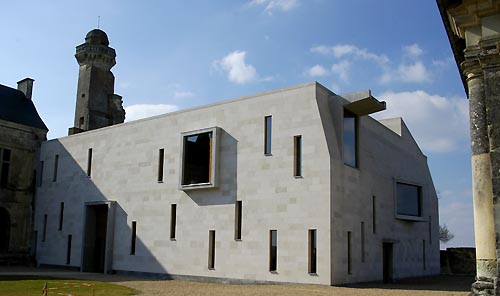
The architect has chosen to go ultra-modern with the design so that it does not become a mere copy of the old building... the materials used are well chosen and the 'neutral' feel of the design doesn't distract from the exhibits.


The improvements over the 'old' museum are immense... for a start there is a real timeline in the two main displays... the geological one is downstairs in the cellars and deals thoroughly with the immediate geology and the fossils that are to be found in the various geological 'levels'.


On the old terrace, now closed in as part of the new building, are three ankle-level displays covering The ascent of man, man from scavenger to modern agriculture and a comparison of art now and in prehistory showing the timelessness of the subjects and the way they are portrayed.


The history of Man timeline, located in the old Renaissance gallery [which also originally housed the prehistory exhibits] has been much improved and runs from the period of Man's origins in the region to the Roman period.


At right angles to the timeline are display cabinets containing examples of tools, weapons and pottery from each period. The original dioramas are still used, but within the timeline.


Returning to the cellars the major flint groups found locally are displayed in the geology section and this leads into a display of the main tool types from the region, followed by a film giving a demonstration of how the 'grand lames' [the very long flint blades] were freed from the core... a superb example of reconstructive archaeology.


It is well worth a visit... and then another!

Wednesday, 24 March 2010

The start of a story

Well, not exactly....
I've started this blog because of the object shown here >>>


 I had posted it on my flickr site and got 136 hits that first day! I was very surprised.

The object is a hammer stone with three working faces showing wear on all faces and a wonderfully polished area where the user had removed two chunks of flint to make it fit his grip.

It fits my grip comfortably  and the two 'hammer' faces are clear of my fingers. I am mainly right-handed.

Unfortunately the hammer stone was found out of context.
We have had a 'fosse touts eaux' [a septic tank] installed and this was in the spoil heap.

The altered areas on the grip are shown below...
the arrows point to the exposed flint, polished by use.

Also use polishing shows on the rough outer surface of the nodule.

The two 'hammer' faces are at different angles and show the most wear at the inner and front side of the 'flat' face [visible on the top picture] and the outside and bottom of the angled face. The 'handle' face also appears to have been used and a flake was removed from the top of the hammer, between the two hammer faces.
This also fits comfortably into my hand with the thumb resting down the concave face [visible in the top picture] and the fingers down the convex face [visible left].


The next picture shows the areas of wear on the hammer faces.

1 & 2 ] The areas of greatest wear are between the arrows...
the curve following the line of wear from blob to blob.


3] This face on the flat hammer is still sharply defined and appears never to have been struck.


I will return to this object once I have taken some better photos.