Touraine - from then until now!

This blog is an attempt to show some of the vast history of Man's prescence in the Southern Touraine.... from first footfall to the present....
especially in and around le Grand Pressigny area.... with special emphasis on life at and around le Moulin de la Forge.
There will also be occasional entries about time before man was here and when the area was at the bottom of a warm, shallow sea...


Showing posts with label Touraine du Sud. Show all posts

Sunday, 14 November 2010

More about Jim the Champignon Champion

On Thursday we visited the mushroom caves of Champion Mushrooms at Loches.... now MPC [Mushroom Production Caves] where they are developing an organic mushroom business in the former production caves of Paris White mushrooms.

While the rain and wind walloped the walnut trees on the hillside, underground all was still. A hundred years ago, things would have been very different. "Le Champion" employed as many as 300 people, and were the first to apply scientific techniques to mushroom production. They perfected a strain of the white Paris mushroom that became a worldwide standard, and researched optimal growing conditions so that for the first time mushrooms could be grown on an industrial scale. They sold fresh mushrooms, but also supported a massive canning operation in Bordeaux, and produced packs of spawn for other growers.

Charles Gillard - Founder of "Le Champion" - in 1900

The temperature in the caves varies by only a couple of degrees, and the Japanese mushrooms now installed there grow without heating, but we saw a huge pit where the coal-fired boiler serving the Paris mushrooms once stood. There was underground stabling for horses, to draw the carts which took the mushrooms down to the railway station. There were dog kennels and even a bread oven. Phillipe Gillard, Jim's business partner, is the great-grandson of the founder of "Le Champion" and drives around the caves in a battered 2CV. Unfortunately we were unable to meet him today, but we look forward to learning more about the history of his family business.

"Your Subterranean Tour Taxi!"

In the meantime we have some of the history that was displayed in an earlier museum that was set up some years ago, as well as some shots of the new style of mushroom growing.
Mushroom growing was only comercialized on the Touraine region in 1854 when Charles Gillard [above] started growing mushrooms in the caves left behind by the quarrymen who supplied the stone to build Loches. There are [as mentioned] 30 hectares of caves on this site... hence the 2CV [and, one hopes, expert knowledge of the way around]

A potted history of mushroom cultivation in Touraine by Paul Gillard


This developed into a business that not only supplied mushrooms to markets but, quite rapidly, began to develope the growing mediums and cultures for successful crops. The poster below shows the growth of the canned mushrooms produced by Gillard and Co from 1902 to 1909. They were marketed as "Royal Champignon".

Growth from just under 500,000 to almost 4 million cans in seven years.
And these are the canners at work.


By the early 1990s they were growing and supplying medium for over a dozen different types of fungi including:

Shiitaké, Paris White, Shaggy Ink-cap [Coprinus comatus], different strains of Oyster Mushrooms [Pleurotus species] and Enokitaké. Some of these are pictured below with onginal pickers baskets.

A cornucopia of fungi


There has even been a Shiitaké beer brewed for a restaurant in Belgium.... apparently it tasted good. But this bottle was empty and I've only got the drinkers word for that.... but he likes a good beer!

Friday, 2 April 2010

Museum re-re-opens

No, that's not a mistake in the title!


 The Musée de la préhistroire du Grand-Pressigny has opened again again!


It had a grand re-opening last September.... then closed for further work and re-opened 'properly' on Sunday the 7th of March.


We've been waiting for this since 2006!!


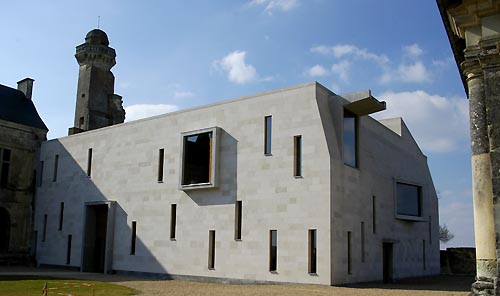
The architect has chosen to go ultra-modern with the design so that it does not become a mere copy of the old building... the materials used are well chosen and the 'neutral' feel of the design doesn't distract from the exhibits.


The improvements over the 'old' museum are immense... for a start there is a real timeline in the two main displays... the geological one is downstairs in the cellars and deals thoroughly with the immediate geology and the fossils that are to be found in the various geological 'levels'.


On the old terrace, now closed in as part of the new building, are three ankle-level displays covering The ascent of man, man from scavenger to modern agriculture and a comparison of art now and in prehistory showing the timelessness of the subjects and the way they are portrayed.


The history of Man timeline, located in the old Renaissance gallery [which also originally housed the prehistory exhibits] has been much improved and runs from the period of Man's origins in the region to the Roman period.


At right angles to the timeline are display cabinets containing examples of tools, weapons and pottery from each period. The original dioramas are still used, but within the timeline.


Returning to the cellars the major flint groups found locally are displayed in the geology section and this leads into a display of the main tool types from the region, followed by a film giving a demonstration of how the 'grand lames' [the very long flint blades] were freed from the core... a superb example of reconstructive archaeology.


It is well worth a visit... and then another!

Wednesday, 24 March 2010

The start of a story

Well, not exactly....
I've started this blog because of the object shown here >>>


 I had posted it on my flickr site and got 136 hits that first day! I was very surprised.

The object is a hammer stone with three working faces showing wear on all faces and a wonderfully polished area where the user had removed two chunks of flint to make it fit his grip.

It fits my grip comfortably  and the two 'hammer' faces are clear of my fingers. I am mainly right-handed.

Unfortunately the hammer stone was found out of context.
We have had a 'fosse touts eaux' [a septic tank] installed and this was in the spoil heap.

The altered areas on the grip are shown below...
the arrows point to the exposed flint, polished by use.

Also use polishing shows on the rough outer surface of the nodule.

The two 'hammer' faces are at different angles and show the most wear at the inner and front side of the 'flat' face [visible on the top picture] and the outside and bottom of the angled face. The 'handle' face also appears to have been used and a flake was removed from the top of the hammer, between the two hammer faces.
This also fits comfortably into my hand with the thumb resting down the concave face [visible in the top picture] and the fingers down the convex face [visible left].


The next picture shows the areas of wear on the hammer faces.

1 & 2 ] The areas of greatest wear are between the arrows...
the curve following the line of wear from blob to blob.


3] This face on the flat hammer is still sharply defined and appears never to have been struck.


I will return to this object once I have taken some better photos.